From Excitement to Dissatisfaction: The Pattern That Keeps Repeating in Romantic Relationships

Our life, including our relationships are mirror reflection of our inner self. What we seek in an ideal partner is what is often lacking within ourselves. These missing elements within ourselves is what makes us want to quest for a partner, the desire to be whole again.
Romantic relations are the ones where life patterns are most evident and lived through. This is mainly because these relationships are the most longed for by humans. The desire to meet the other half is so strong that we are willing to go to any lengths to achieve it. This is the reason why most life patterns are experienced through this, an illusion to be whole again. Being in a relationship also provide us with an identity and a life purpose. The identity of being a husband, wife or parent hold a great significance, and it holds a status in a society. Therefore, people chase this status despite the absence of the desire.
Relationships become an easy gateway for patterns to enter, repeat and break eventually. Now, an alliance can exacerbate the existing patterns, this is when a partnership starts to feel heavy. Alternatively, it can support us with overcoming them. Ultimately, making it a transactional relationship, both partners benefit consciously and subconsciously.
Very few recognise such patterns and walk away from an alliance which no longer feels aligned, however most stay in it as it becomes mind’s comfort zone, a familiar situation that the mind knows how to deal with i.e., autopiloting. The aftermath appears to be harder for the mind than staying in an existing relationship.
These days people experience multiple relationships in one lifetime. The challenges remain the same despite different partners. We hope that meeting someone different is the answer to changing a situation, however most of us are disappointed when we meet emotional unavailable partner repeatedly. The type of partners, the situation, relationship dynamics often repeat until it is broken with conscious decision. It may also be likely these patterns have becomes a norm, in such cases, the pattern loop will continue to repeat.
There are stages in a relationship. There are initial stages of excitement, boredom and expectations, followed by middle stage of awareness and decision and final stage of inner change. Multiple loops can be experienced by an individual depending on the stages, which prevents them from reaching the end goal of inner change. These pattern loops depend on individual’s subconscious tendencies, past experiences and intuition, not all individuals may experience the same pattern loops despite being in the same stage.

The value of a relationship is only questioned when expectations are not met.
Every relationship starts with an excitement. There is thrill in getting to know another person, spending time together and anticipating what the future holds with optimism. At initial stages, there are limited expectations as it is not the primarily focus.
Once a relationship becomes official, the initial excitement starts to plateau. The chasing of our desired partner comes to an end, and it is therefore replaced with boredom. At this point, excitement seeking pattern loop can emerge. An individual repeatedly seeks excitement and struggles to settle down. Once the excitement starts to deplete, another excitement is sought. This results in them having multiple potential partners with no commitment.
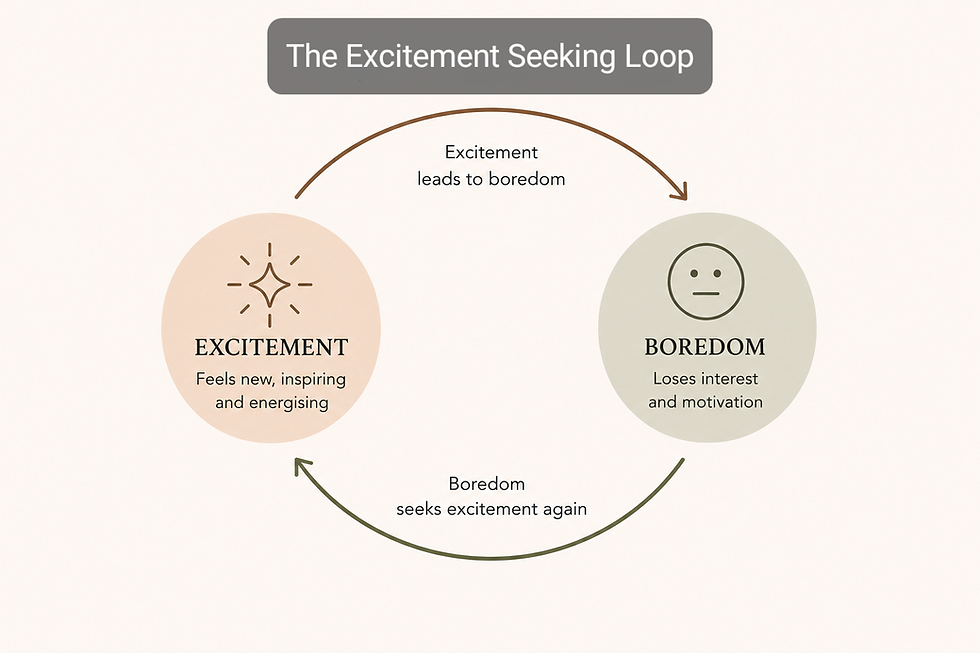
When the mundane day to day life starts to feel heavy and if another excitement is not pursued, this is when we start asking the question of purpose of our relationship in life?
In response, we begin to justify and rationalise focusing on companionship, shared growth, security, and long-term stability. At the same time, we may start to evaluate the relationship in terms of balance, comparing what we give with what we receive.
Expectations starts to creep in when commitment is established. While partners seek to experience life together, this reliance can turn into obligations. The feeling of enjoyment starts to diminish and responsibilities take precedence.
If there is any imbalance in a relationship, this starts to become visible now as it is no longer hidden behind the initial excitement. It is at this point boundary setting and expectations from the partner starts shifting into demands and can feel mandatory. There is a growing need for fairness, self-care, and preservation of identity along with the fear of losing oneself in the process.
Overall, the love which was once felt selfless and effortless can become to feel heavy. It is often within this phase that self-awareness should deepen. However, at this stage individual often divert towards fixation. The focus becomes on trying to change the partner, mould them so they can fulfil the missing gaps within self. There is a belief that our happiness is dependent on them changing. Therefore, great efforts are made into shaping the partner’s life instead of self.
When attempts are unsuccessful, this creates pattern loop of expectations – dissatisfaction, as the mind keeps reverting to initial belief that it is the partner that requires adjustment for their own state of happiness. When expectations are not met, the feeling of frustration arises. Eventually leading to withdrawal for short period of time and starting the loop again with expectations.

Even when a relationship no longer feels fulfilling, a person may remain because it continues to satisfy personal needs or desires. Comfort and personal benefits begin to outweigh emotional fulfilment and happiness.
Sometimes it becomes evident that a relationship no longer aligns with our life purpose. Despite this, most people stay.
Practicality is often chosen over truth and pros and cons are evaluated. The list of pros often tends to be longer as it will include aspects such as comfort, security, familiarity and personal gain or desires.
Whilst the cons list includes sacrifice of emotional fulfilment and overall happiness in addition to new changes which will need to be adjusted into. This can be quite uncomfortable for the mind to comprehend. It starts to think of all the possible challenges that it will encounter and will need to be solved through self-efforts.
The need to compromise would seem like a sound judgement. Individuals start settling in for less than what their heart truly desires, creating expectation – compromise loop.

The comfort and personal gain are prioritised, while emotional fulfilment is quietly sacrificed. Ultimately, alliances have remained into are not out of love but to fulfil a life agenda.
Though these are main aspects others such as society and family expectations, children upbringing and emotional manipulation should also be recognised and acknowledged.
Without “awareness” the final stage of inner change cannot be reached. The loops therefore continue either with the initial stages, initial – second stages, second stages or second – final stages, creating repeated cycles.
True love is unconditional. It carries no expectations, desires, motives, or personal gain. To experience this kind of love externally, the journey of self-love must first be walked within.
Now, let's explore possible life themes for the initial stage pattern loops.
Excitement Seeking
The excitement seeking loop potentially carries a pattern, lack of commitment due to fear of losing oneself and trust. This possibly translates into a life lesson of attachment, trust and dependence, opposite side of polarity to independence and detachment.
Expectations – Dissatisfaction & Expectations - Compromise
These loops can potentially carry the life theme of learning attachment or insecurity or reciprocity.
These life themes can be confirmed by looking at how these patterns reflect in other aspects of an individual's life such as work and family dynamics as well the mechanisms for coping.
We build identities through our relationships with people, roles, and attachments. But beneath all of them lies the most important one: the relationship with the self. It is this connection that reveals who we truly are.